
Stick welding accessories are essential for maintaining reliable arc welding performance in fabrication, repair, and construction applications. WeldingMart stocks professional stick welding accessories including electrode holders, welding leads, and other tools designed for dependable Shielded Metal Arc Welding (SMAW) performance in both shop and field environments.
-


Lincoln HydroGuard Bench Welding Rod Oven 240/480 V K2942-2
$3,346.37$4,173.56Unit price /Unavailable

Lincoln Flexible Welding Cable Reel 2/0 500 FT K5475-2/0-500
$4,075.07$4,683.41Unit price /Unavailable

Lincoln Electrode Holder and Lead #2, Tweco Plug to EH200, 15ft K5161-2-15
$136.95$165.34Unit price /Unavailable


Lincoln Stick Electrode Holder, Cable (w/Twist-Mate) K2374-1
$180.37$183.34Unit price /Unavailable
Lincoln EH-405HD Electrode Holder 400A, 60% Duty Cycle K909-8
$95.70$157.47Unit price /Unavailable
 $607.99Unit price /Unavailable
Lincoln Flexible Cable Work Lead 2/0 with Tweco Male & Ground Clamp 25 FT K5435-2/0-25
$246.80$333.72Unit price /Unavailable


Lincoln Weld Cable Package Work Lead TM & GC500 Ground Clamp (2/0, 350A, 60%) 15 ft (4.6 m) K1803-3
$293.35$306.94Unit price /Unavailable

Lincoln RP6 Weldable Rust Preventative Fluid 5 Gallon Pail K4127-2
$362.83$436.29Unit price /Unavailable
Lincoln Flexible Cable Work Lead 2 AWG with 200A Electrode Holder & Lug 12.5 FT K5436-2-12-1/2
$82.27$111.24Unit price /Unavailable

Lincoln HydroGuard Bench Welding Rod Oven 115/120 V K2942-1
$3,397.37$4,173.56Unit price /Unavailable

Harris Super Cold-Galv Zinc-Galvanizing Solution 13oz. Spray Can (Box of 12) - SUPCG0D13
$199.00Unit price /Unavailable
Lincoln RP6 Weldable Rust Preventative Fluid 55 Gallon Drum K4127-1
$3,170.99$3,645.17Unit price /Unavailable

 $99.59
$134.93Unit price /UnavailableLincoln Weld Cable Tweco Male & Female (3/0, 600A, 60%) 50 ft (15.3 m) K2485-3
$1,175.49$1,290.05Unit price /Unavailable
Lincoln Flexible Cable Work Lead 2/0 with Ground Clamp & Lug 25 FT K5434-2/0-25
$255.47$346.08Unit price /Unavailable
Lincoln Welding Blanket - 6 ft x 6 ft - 550° C Rated - K3253-1
$119.71$128.25Unit price /UnavailableLincoln Weld Cable Tweco Male & Female (2/0, 350A, 60%) 50 ft (15.3 m) K2485-2
$837.75$1,032.22Unit price /Unavailable
Lincoln EH-305HD Electrode Holder 300A, 60% Duty Cycle K909-7
$70.63$122.57Unit price /Unavailable
Lincoln Flexible Cable Work Lead 2/0 with Tweco Male & Ground Clamp 50 FT K5435-2/0-50
$255.47$346.08Unit price /Unavailable


Lincoln Flexible Cable Work Lead 2/0 with Ground Clamp & Lug 50 FT K5434-2/0-50
$441.65$597.25Unit price /Unavailable
Lincoln Weld Cable Tweco Male & Open End (3/0, 600A, 60%)- 10 ft (3 m) K2483-3
$255.39$279.02Unit price /Unavailable
 $561.37
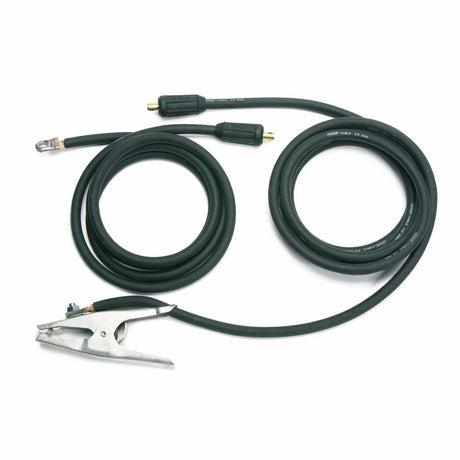
$620.06Unit price /UnavailableLincoln Weld Power Cable TM to Lug (1/0, 350A, 60%) 10 ft (3 m) K1840-10
$313.75$380.61Unit price /Unavailable

Every stick welding setup is only as good as the accessories around it. A weak electrode holder gets hot and shocks you. A bad ground clamp throws an erratic arc and ruins the bead. Wet or damaged 7018 rods crack the weld bed before the slag chips off. WeldingMart stocks the full Lincoln Electric and aftermarket stick welding accessory lineup — 82 SKUs covering electrode holders (stingers), ground clamps, welding leads and lead extensions, cable connectors and adapters, rod ovens, rod storage tubes, and arc-strike protection.
Shop Stick Welding Accessories by Category
Electrode Holders (Stingers)200A, 300A, 400A, and 500A-rated stingers from Lincoln, Tweco, and Lenco. Spring-loaded jaws with replaceable insulator covers.
Ground Clamps & Work ClampsSpring-loaded and screw-down ground clamps from 200A through 600A. Copper-jaw and brass-jaw options for high-amp duty.
Welding Leads & Cable SetsPre-made lead sets in 1/0, 2/0, 4/0 AWG \u2014 25 ft, 50 ft, 100 ft lengths with pre-installed lugs and connectors.
Cable Connectors & AdaptersTwist-lock Tweco-style and Dinse-style male/female connectors, lead extension couplers, and machine-to-cable adapters.
Rod Ovens & StoragePhoenix and Keen rod ovens (10 lb to 50 lb capacity) plus heated rod stabilizers and pocket-size storage tubes for 7018 / low-hydrogen rods.
Stick Rods & Electrodes →Pair your accessories with the right rod \u2014 Excalibur 7018, Fleetweld 5P+/180/37, Pipeliner, stainless 308L/309L/316L (487 rod SKUs).
Stick Accessory Sizing — Match Cable, Holder, and Clamp to Your Welder Output
Mismatched accessory ratings are the #1 cause of arc instability and burned-up gear on stick welding setups. The rule is simple: every component in the circuit must be rated for the maximum amperage your welder can output, including the duty cycle. A 200-amp electrode holder on a 250-amp Idealarc 250 will overheat and melt the insulator at full output. A 4 AWG ground lead feeding a 300-amp Invertec V276 will drop voltage and pull the arc into the lead instead of the joint.
Holder and clamp sizing rule of thumb:
- Up to 150 A welder output: 200A-rated stinger and ground clamp, 1/0 AWG cable
- 150–225 A (AC-225, V155-S, Sprinter 180Si): 300A holder, 300A clamp, 2/0 AWG cable for runs over 25 ft
- 225–300 A (V276, Idealarc 250): 400A–500A holder, 400A+ clamp, 2/0 or 4/0 AWG cable
- 300 A and up (industrial): 500A+ holder, 4/0 AWG cable, dual ground clamps for heavy plate
Rod Ovens and Storage — Critical for 7018 and Low-Hydrogen Work
If you're running E7018 (Lincoln Excalibur 7018 MR) or any other low-hydrogen rod for code work, a rod oven is non-optional. Low-hydrogen rods absorb atmospheric moisture from the moment the hermetic can is opened, and once they hit ~0.4% moisture by weight they will crack any X-ray-quality weld they touch. AWS D1.1 Section 5.3.2 requires 7018 rods be held at 250°F minimum after the can is opened. We carry the Phoenix DryRod and Keen oven lines covering 10 lb shop ovens through 50 lb high-capacity stabilizers, plus the smaller portable rod canisters that pipefitters wear on a belt.
For storage of unopened rod cans and non-low-hydrogen rods (6010, 6011, 6013), heated rod storage tubes work fine. Don't make the mistake of using a wood-shop oven \u2014 baking 7018 above 800°F destroys the flux coating permanently.
Why Buy Stick Accessories From an Authorized Lincoln Distributor
WeldingMart is a Lincoln Electric authorized distributor, and our buyers know the spec differences between a Lincoln K2188-3 electrode holder (a 300A spring-loaded model with thermoplastic insulator) and the cheaper imports that have the same shape but use phenolic resin that cracks after a season. We carry the Lincoln Magnum stick accessory line, the Tweco Tongs and Stinger holders, Lenco copper-alloy ground clamps, and the Phoenix and Keen rod oven lines that meet AWS storage requirements. Same-day shipping on in-stock items. For technical questions on accessory sizing for a specific Lincoln machine or weld procedure, call us at 1-800-293-4483.
Cross-shop our other stick welding categories: Lincoln Electric Stick Welders (24 machines), Stick Welding Rods & Electrodes (487 rod SKUs), and the Lincoln Electric Stick Welding Guide for machine-and-rod selection guidance.


