
WeldingMart stocks a full range of welding cables and welding leads for stick (SMAW), engine-driven, and multi-process welding — from compact 10-foot whip leads to 110-foot extension runs. #2, 1/0, 2/0, 3/0, and 4/0 AWG copper conductors rated for 200A to 600A continuous duty. Connector configurations include Lug-to-Lug, Twist-Mate, Tweco, Lenco LC-40, and Dinse ends. All cables feature flexible insulation rated for industrial use at 90°C. Lincoln Electric, Direct Wire, and WeldingMart custom-assembled leads in stock — ships fast.
-


 $607.99Unit price /Unavailable

Lincoln Flexible Cable Work Lead 2/0 with Tweco Male & Ground Clamp 25 FT K5435-2/0-25
$246.80$333.72Unit price /Unavailable
Lincoln Flexible Welding Cable Reel 2/0 500 FT K5475-2/0-500
$4,075.07$4,683.41Unit price /Unavailable
Lincoln Weld Cable Package Work Lead TM & GC500 Ground Clamp (2/0, 350A, 60%) 15 ft (4.6 m) K1803-3
$293.35$306.94Unit price /Unavailable
Lincoln Work Lead Lug & GC500 Ground Clamp (2/0, 350A, 60%) 15 ft (15.3 m) K2150-1
$294.87$298.70Unit price /Unavailable
Lincoln Flexible Cable Work Lead 2 AWG with 200A Electrode Holder & Lug 12.5 FT K5436-2-12-1/2
$82.27$111.24Unit price /Unavailable
Lincoln Flexible Cable Work Lead 2/0 with Tweco Male & Ground Clamp 50 FT K5435-2/0-50
$255.47$346.08Unit price /Unavailable
Lincoln Flexible Cable Work Lead 2/0 with Ground Clamp & Lug 25 FT K5434-2/0-25
$255.47$346.08Unit price /UnavailableLincoln Weld Power Cable TM to Lug (1/0, 350A, 60%) 10 ft (3 m) K1840-10
$313.75$380.61Unit price /UnavailableLincoln Weld Cable Tweco Male & Female (3/0, 600A, 60%) 50 ft (15.3 m) K2485-3
$1,175.49$1,290.05Unit price /UnavailableLincoln Weld Cable Tweco Male & Female (2/0, 350A, 60%) 50 ft (15.3 m) K2485-2
$837.75$1,032.22Unit price /Unavailable
Lincoln Weld Power Cable Lug to Lug (3/0, 600A, 60%) 10 ft (3 m) K1842-10
$276.17$335.02Unit price /Unavailable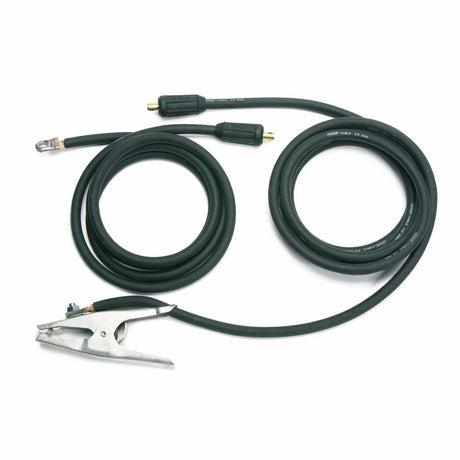 $561.37
$620.06Unit price /UnavailableLincoln WeldingMart 50' Cable Package with Ends and Quick Disconnects and Terminal Connectors
$600.00Unit price /Unavailable $99.59
$134.93Unit price /UnavailableLincoln Weld Cable Tweco Male & Open End (3/0, 600A, 60%)- 10 ft (3 m) K2483-3
$255.39$279.02Unit price /Unavailable
Lincoln Flexible Cable Work Lead 2/0 with Ground Clamp & Lug 50 FT K5434-2/0-50
$441.65$597.25Unit price /UnavailableLincoln Weld Power Cable Lug to Lug (4/0) 35 ft (10.6 m) (2 cables/package) K2163-35
$1,462.92$1,653.64Unit price /Unavailable
Lincoln Weld Power Cable Lug to Lug (4/0, 600A, 60%) 110 ft (33.5 m) K1842-110
$2,341.48$2,637.25Unit price /Unavailable
Lincoln Weld Power Cable Lug to Lug (3/0, 600A, 60%) 35 ft (10.6 m) K1842-35
$639.80$776.15Unit price /Unavailable
Lincoln Weld Power Cable Lug to Lug (3/0, 600A, 60%) 60 ft (18.3 m) K1842-60
$1,145.95$1,276.90Unit price /UnavailableLincoln Flexible Welding Cable Reel 2 AWG 500 FT K5475-2-500
$2,546.92$2,927.26Unit price /Unavailable
Lincoln Weld Power Cable Twist Mate to Twist Mate (2/0, 350A, 60%) 50 ft (15.2 m) K1841-50
$890.53$976.07Unit price /UnavailableLincoln Weld Power Cable Lug to Lug (4/0) 60 ft (18.3 m) (2 cables/package) K2163-60
$2,264.96$2,492.06Unit price /Unavailable
Lincoln Weld Cable Tweco Male & Open End (2/0, 350A, 60%) 10 ft (3 m) K2483-2
$209.35$214.83Unit price /Unavailable
Lincoln Weld Power Cable TM to TM (1/0, 350A, 60%) 25 ft (7.6 m) K1841-25
$511.90$617.96Unit price /Unavailable
What Is a Welding Lead / Welding Cable?
A welding lead — also called a welding cable — is the flexible, heavily insulated copper conductor that carries welding current from a power source to the electrode holder or work clamp and back. The terms are used interchangeably in the field: "welding lead" is the jobsite term most pipe welders and ironworkers use; "welding cable" is the electrical-specification term used by engineers citing NFPA 70 / National Electrical Code (NEC) Article 630.
Welding cable construction begins with a fine-stranded copper core. Unlike building wire, welding cable uses bare copper strands that are individually tinned or bare, then bundled into a rope-lay conductor. The number of strands matters: consumer-grade cable may use as few as 133 strands, while professional-grade Class K cable uses 2,109 strands in 4/0 AWG, and Class M cable uses even finer stranding — 5,292 strands — for maximum flexibility in confined spaces and overhead work. More strands mean a softer, more pliable cable that resists kinking and fatigue cracking over thousands of flex cycles on a busy shop floor or pipeline job.
The insulation jacket encases the copper core and must handle high heat, ultraviolet exposure, oil, grease, cutting fluids, and abrasion. Three insulation materials dominate the welding market:
- EPDM (Ethylene Propylene Diene Monomer): The industry standard for shop and jobsite work. EPDM remains flexible at temperatures as low as –40 °F (–40 °C), resists UV, ozone, and most solvents, and is rated for 90 °C conductor temperature. It is the material specified on virtually all Lincoln Electric welding leads. (Lincoln Electric Cables & Leads)
- Neoprene (CR Rubber): Excellent oil and flame resistance. Used in older cable designs and some heavy-industry environments with high petroleum exposure. Slightly stiffer than EPDM below freezing.
- Polyurethane (PUR): Premium choice for push-pull cable and wire feeder applications. Exceptional abrasion resistance and cut resistance — common on MIG gun cables and robotic welding cells.
AWG sizing determines current-carrying capacity. Standard welding cable gauges run from #2 AWG (200A light-duty) through 1/0 AWG (300A), 2/0 AWG (350A), 3/0 AWG (450A), and 4/0 AWG (600A at 60% duty cycle). Amperage ratings assume a 60% duty cycle per NFPA 70 Article 630 and total combined lead length (work lead + electrode lead). Lincoln Electric cable specifications conform to ANSI/ASTM B172 rope-lay stranded copper and UL 44 / UL 854 insulation requirements.
How to Choose Welding Cable
Selecting the right welding cable requires matching four variables: amperage output, total lead length, duty cycle, and operating environment. Getting any one of these wrong costs money — either in prematurely failed cable or in dangerous voltage drop that robs arc performance.
Step 1 — Match Amperage to AWG
Start with your welder's maximum output amperage. A 200-amp stick welder can run #2 AWG for short runs. A 400-amp pipeline welder needs 2/0 AWG minimum. A 600-amp engine-driven welder driving two operators requires 4/0 AWG cable with cam-lock or Twist-Mate connectors at each end. Always size for the welder's maximum output, not your typical working amperage — cable running at or above its thermal limit will harden, crack, and eventually arc internally.
Step 2 — Measure Total Lead Length
The ampacity chart assumes a combined lead length — the electrode lead plus the work lead, end to end. A 25-foot electrode lead and a 25-foot work lead equals a 50-foot combined run. Every additional 25 feet of cable reduces effective current at the arc and increases resistive heat in the copper. When total combined lead length exceeds 100 feet, jump one AWG size up to compensate for voltage drop. Lincoln Electric's sizing guidelines follow this same combined-length calculation method.
Step 3 — Factor in Duty Cycle
Duty cycle is the percentage of a 10-minute period the welder is actively arcing. At 60% duty cycle — the NEC standard reference point — the cable's rated ampacity is the published figure. Heavy production welding at 100% duty cycle requires derating the cable by approximately 15–20%, which typically means jumping one AWG size. Pipe welders burning 7018 at continuous passes should use 2/0 minimum even for 250A output when duty cycle runs high.
Step 4 — Assess the Environment
- Indoor shop: Standard EPDM jacketed cable works in all applications. Class K stranding (2,109 strands in 4/0) is sufficient for shop floor use.
- Outdoor / jobsite: EPDM is UV-resistant and handles temperature extremes. Prioritize cables with thicker jacket walls (3/16" or more in 2/0 and up) for abrasion resistance on concrete and steel decking.
- Cold weather / below-freezing: EPDM rated to –40 °F. Avoid PVC-jacketed imports — PVC becomes brittle below 20 °F and will crack when coiled.
- Oil and petroleum exposure: Neoprene or PUR jacketed cable. Pipeline and refinery environments with diesel, hydraulic fluid, or cutting oil exposure will degrade EPDM over time.
- Confined spaces / overhead work: Class M (5,292 strands in 4/0) — the softer, lighter cable makes a measurable difference in fatigue and ease of handling in tight quarters.
Welding Cable AWG Size Chart
The following ampacity ratings are based on 60% duty cycle, EPDM-jacketed copper welding cable, and combined lead lengths (electrode + work lead combined). Values align with NFPA 70 (NEC) Article 630 Table 630.31 and Lincoln Electric cable specification charts.
AWG Size Max Amps @ 60% Duty Cycle Combined Lead Length Recommended Use Case Typical Application #2 AWG 200A Up to 50 ft Light shop duty Small stick welders, MIG whip leads, TIG torch cable 1/0 AWG 300A Up to 75 ft Light–medium shop 200–300A stick, wire feeder power leads, engine-driven light setup 2/0 AWG 350A Up to 100 ft Medium duty / production 300–400A stick/MIG, engine-driven single-operator, pipe root pass 3/0 AWG 450A Up to 150 ft Heavy production 400–500A engine-driven, heavy structural, multi-pass pipe cap 4/0 AWG 600A Up to 200 ft Pipeline / heavy industrial 500–600A engine-driven, cross-country pipeline, preheat leads When combined lead length exceeds the maximums above, increase one AWG size. For 100% duty cycle continuous welding, increase one AWG size from the table value. Always consult NFPA 70 Article 630 for code-compliant installations.
Top Welding Cable Categories
WeldingMart stocks welding leads in every configuration used in professional welding and cutting. Here are the main cable types and their applications:
Whip Cable (Electrode Lead)
The short cable — typically 10 to 25 feet — that runs from the welder output terminal to the electrode holder or MIG gun. Whip cables absorb the most punishment: constant flexing, heat cycling, and dragging across rough surfaces. Lincoln Electric whip leads use EPDM insulation with reinforced jacket construction at both end terminations. Standard Lincoln whip leads are 2/0 AWG with Twist-Mate, Tweco-style, or bare lug terminations. See the full welding leads collection for all Lincoln whip cable options.
Ground Cable (Work Lead)
The work lead runs from the welder's negative terminal (DCEN) or ground stud to the work clamp or ground clamp clamped to the base metal or welding table. Ground cable sizing must match the electrode lead — an undersized work lead creates as much arc-quality problems as an undersized electrode lead. Lincoln work leads are available with GC500 ground clamps, Twist-Mate connectors, or bare lug ends in 15-, 25-, 35-, and 50-foot lengths.
Primary Lead (Extension Cable)
Extension leads add run length between the welder and the work area without permanently lengthening the whip. Male/female connector pairs (Tweco-style male + female, Twist-Mate to Twist-Mate, or cam-lock style) allow quick assembly and teardown. Lincoln's K2485 series provides 2/0 and 3/0 extension leads in 50-foot lengths with factory-terminated Tweco-style male and female connectors. Always calculate combined lead length (whip + extension + work lead) when sizing — do not exceed the AWG ampacity limits in the table above.
MIG Gun Cable
MIG gun cables (also called MIG power cables or MIG leads) carry both welding current and shielding gas from the wire feeder to the MIG gun. They include an inner liner for wire feeding, a gas passage, a current-carrying copper conductor, and a trigger control lead. Lincoln Electric MIG gun cable assemblies use PUR outer jackets for abrasion resistance. Replacement MIG gun cables for Lincoln Magnum 100L, 200, and 300 guns are available in the MIG Welding Cables & Power Pins collection.
TIG Torch Cable
TIG torch leads carry DC or AC current, shielding gas, and — on water-cooled torches — cooling water supply and return. TIG torch cables are typically #2 or 1/0 AWG for 150–200A air-cooled work and use specialized torch body fittings (Dinse, Twist-Mate, or direct crimp). Lincoln TIG cables are compatible with Precision TIG, Square Wave TIG, and Invertec TIG platforms.
Push-Pull Cable
Push-pull cables are used in aluminum MIG welding where the standard wire feeder push system cannot reliably feed soft 4043 or 5356 aluminum wire over runs longer than 10–12 feet without birdnesting. A push-pull system places a drive motor inside the gun body to pull wire simultaneously. These cables use PUR jacketing and specialized inner liners (Teflon or conduit liner). Lincoln Electric's Magnum PRO push-pull systems use proprietary push-pull cable assemblies available through WeldingMart.
Compatible Accessories
Welding cables are only as good as their termination hardware. The following accessory collections pair directly with the cables in this collection:
- Electrode Holders & Stingers: 200A, 300A, 400A, and 600A electrode holders for stick (SMAW) welding. Lincoln and MK Products stingers with screw-type and cam-type jaw mechanisms. → Welding Electrode Holders & Stingers
- MIG Welding Cables & Power Pins: Replacement MIG gun cables, Tweco-compatible power pins, and MIG cable assemblies for Lincoln Magnum gun systems. → MIG Welding Cables & Power Pins
- Cable Accessories & Remotes: Welder remote controls, cable strain reliefs, heat shrink termination kits, and cable management accessories. → Welder Remotes, Cables & Accessories
Bulk Cable + Connector Kit: WeldingMart offers cable packages that combine bulk Lincoln welding cable reels (500-foot, 2 AWG or 2/0 AWG) with factory-terminated end assemblies and quick-disconnect hardware — the fastest way to build out a multi-station shop or engine-driven job site setup. See the Welding Cables & Leads collection for current bundle configurations, including the Lincoln K5475-2/0-500 (500-foot 2/0 EPDM reel) and custom-length cut cable assemblies.
Frequently Asked Questions — Welding Leads & Welding Cable
- What AWG welding cable do I need for a 200-amp welder?
- For a 200-amp welder with combined lead lengths up to 50 feet, #2 AWG welding cable is sufficient at 60% duty cycle. If your total electrode lead plus work lead exceeds 50 feet, step up to 1/0 AWG to stay within NFPA 70 Article 630 ampacity limits and avoid excessive voltage drop at the arc. Lincoln Electric's standard lead assemblies for 200-amp machines are #2 AWG, 12.5- or 25-foot lengths (see K5436 and K4893 series).
- What is the difference between 1/0 and 2/0 welding cable?
- The AWG (American Wire Gauge) numbering system is inverse — larger numbers after the slash mean larger wire. 1/0 AWG (pronounced "one-aught") has a copper cross-section of approximately 53 mm² and is rated to 300 amps at 60% duty cycle. 2/0 AWG ("two-aught") has a cross-section of approximately 67 mm² and is rated to 350 amps. The jump from 1/0 to 2/0 is modest in diameter but meaningful for long lead runs or high duty-cycle applications. Lincoln Electric's most common lead configurations (K1803, K1840, K1841, K1842, K2485 series) use 2/0 AWG as the standard for engine-driven welders in the 300–400A class.
- How long is too long for a welding lead?
- There is no hard maximum, but voltage drop becomes the limiting factor. Every 25 feet of welding cable at maximum amperage drops approximately 0.5–1.0 volt. For a stick welder operating at 25–32 arc volts, a 200-foot combined lead run can cost 4–8 volts — enough to noticeably destabilize the arc. The practical rule: keep combined lead length under 150 feet for routine production welding. For runs beyond 150 feet, jump one AWG size and use high-quality Tweco or Twist-Mate connectors at each junction. For fixed installations exceeding 200 feet, consider a remote wire feeder or a second power source closer to the work.
- Can I splice welding cable?
- Yes, but only with proper connectors — never with electrical tape alone. NFPA 70 (NEC) Article 630.42 permits welding cable splices when they are mechanically strong, electrically continuous, and re-insulated to the original cable's insulation rating. The correct approach is to use crimp-type cable lugs (copper barrel, heavy-duty crimp) on each cable end and then join them with a cam-lock type connector or Tweco-style male/female pair — the same connectors used on extension leads. Bare copper lugs twisted together and wrapped in tape fail at the connection point under thermal cycling and are a fire and shock hazard.
- What is the best insulation for welding cable?
- For general shop and jobsite welding, EPDM-jacketed cable is the best choice for the widest range of conditions. EPDM stays flexible from –40 °F to 194 °F (–40 °C to 90 °C), resists UV degradation, ozone, and most shop chemicals, and has an excellent track record in pipeline construction and heavy fabrication. For environments with heavy petroleum exposure (oil fields, refineries, machining shops with cutting oil), neoprene offers better oil resistance. For push-pull aluminum MIG cable and robotic welding cell leads, PUR (polyurethane) provides superior abrasion and cut resistance. Lincoln Electric's welding leads use EPDM as the standard insulation across the K-series cable line.
- Is Class K cable better than Class M cable?
- Both Class K and Class M welding cable meet ANSI/ASTM B172 copper stranding requirements. The difference is strand count and flexibility: Class K uses 2,109 strands in 4/0 AWG and is the standard for shop floor and general jobsite use. Class M uses 5,292 strands in 4/0 AWG — nearly 2.5× more, finer-gauge individual strands — making it noticeably softer, lighter, and more resistant to fatigue cracking under continuous flexing. Class M is the choice for confined-space work, overhead welding, and applications where the cable is in constant motion. For most shop and field welding, Class K is excellent. For pipe welders working inside pipe or in tight boiler spaces, Class M is worth the premium.
- How do I size welding cable for voltage drop?
- Voltage drop in welding cable follows Ohm's Law: \(V_{drop} = I \times R\), where \(R\) is the cable resistance in ohms for the total combined lead length. For 2/0 AWG EPDM welding cable, resistance is approximately 0.328 mΩ/ft (milliohms per foot). For a 100-foot combined run at 350A: \(V_{drop} = 350 \times (0.000328 \times 100) = 11.5\) volts — roughly a third of the arc voltage on a 30V stick arc. Practical target: keep voltage drop under 4 volts total for stable arc performance. To calculate: (amperage × combined lead length in feet × cable resistance per foot) ÷ 1,000. When voltage drop exceeds 4V, increase cable AWG one size. Lincoln Electric's cable sizing tools and the NEC Article 630 ampacity tables provide pre-calculated sizing guidance for the most common welding configurations.


