
Stick welding rods, also known as stick electrodes or arc welding rods, are used for reliable welding performance in field, repair, and structural applications. Designed for use with stick welders, these electrodes provide strong penetration and stable arc control across a wide range of materials and conditions. Common options such as 6010, 6011, and 7018 allow welders to match electrode type to the job, whether working outdoors, on dirty materials, or in high-strength structural welding. Available in multiple classifications including 6010, 6011, and 7018, allowing welders to select the right rod for penetration, strength, and welding conditions.
-

Lincoln ED032877 Excalibur 7018 A1 MR Stick SMAW Welding Rod 5/32X14in 50 lb Easy Open Can
$345.93$406.50Unit price /Unavailable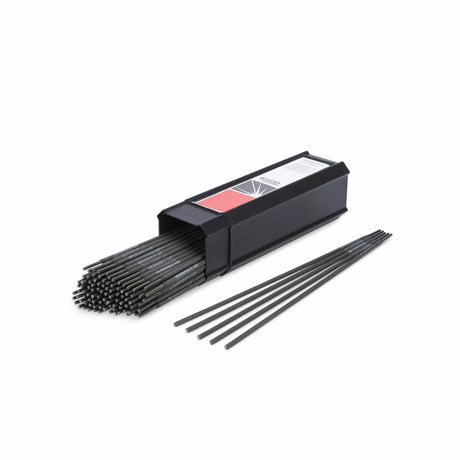
Lincoln ED022011 Wearshield 60 Stick SMAW Welding Rod 5/32 14in 10 lb Plastic Tube
$139.53$152.60Unit price /Unavailable
Lincoln ED034456 Pipeliner Arc 80 Stick SMAW Welding Rod 5/32 14in 50 lb Easy Open Can
$320.25$376.00Unit price /Unavailable
Lincoln ED028153 Fleetweld 35 Stick SMAW Welding Rod 1/8X14in 50 lb Easy Open Can
$274.25$324.00Unit price /Unavailable
Lincoln ED021998 Wearshield Abr Stick SMAW Welding Rod 5/32 14in 10 lb Plastic Tube
$78.74$113.80Unit price /Unavailable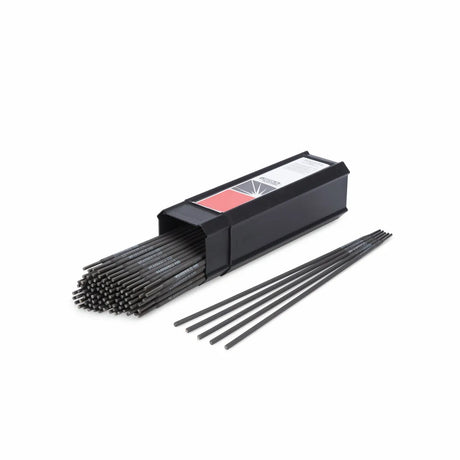
Lincoln ED021976 Wearshield Mangjet Stick SMAW Welding Rod 5/32 14in 10 lb Plastic Tubes
$113.35$114.80Unit price /Unavailable
Lincoln ED034457 Pipeliner Arc 80 Stick SMAW Welding Rod 3/16 14in 50 lb Easy Open Can
$322.25$379.50Unit price /Unavailable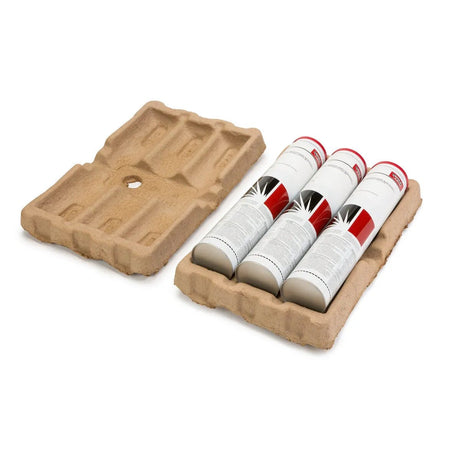
Lincoln ED037425 Excalibur 7018 XMR Stick SMAW Welding Rod 3/32X14in 3 10 lb Easy Open Can
$181.75$219.00Unit price /Unavailable
Lincoln ED030826 Pipeliner 8P Stick SMAW Welding Rod Electrode 1/8 14in 50 lb Easy Open Cans
$327.48$383.00Unit price /Unavailable
Lincoln ED033079 Excalibur 308L 16 Stick SMAW Welding Rod 3/32 12in 8 lb Easy Open Can
$124.00$166.96Unit price /Unavailable
Lincoln ED033838 Excalibur 7018 MR N Stick SMAW Welding Rod 1/8 14in 3 10 lb Easy Open Cans
$229.38$274.80Unit price /Unavailable
Lincoln ED010105 Fleetweld 180 Stick SMAW Welding Rod 1/8X14in 50 lb Easy Open Can
$349.25Unit price /Unavailable
Lincoln ED030827 Pipeliner 8P Stick SMAW Welding Rod 5/32 14in 50 lb Easy Open Cans
$323.25$380.50Unit price /Unavailable
Lincoln ED035021 Excalibur 630-16 Stick SMAW Welding Rod 5/32 14in 10 lb Easy Open Can
$343.66Unit price /Unavailable
Lincoln Edm13181215 Murex 7024 Stick SMAW Welding Rod 5/32X14in 50 lb Carton
$279.00Unit price /Unavailable
Lincoln ED035020 Excalibur 630-16 Stick SMAW Welding Rod 1/8 14in 10 lb Easy Open Can
$254.08Unit price /Unavailable
Lincoln ED033104 Excalibur 316 316L 16 Stick SMAW Welding Rod 3/32X12in 8 lb Easy Open Can
$239.76Unit price /Unavailable
Lincoln ED028154 Fleetweld 35 Stick SMAW Welding Rod 5/32X14in 50 lb Easy Open Can
$277.96$319.50Unit price /Unavailable Sold out
Lincoln ED012849 Shield Arc 70 Stick SMAW Welding Rod 5/32X14in 50 lb Easy Open Can
$316.50Unit price /Unavailable Sold out
Lincoln ED012845 Shield Arc 70 Stick SMAW Welding Rod 3/16X14in 50 lb Easy Open Can
$316.00Unit price /UnavailableWeldingMart is a Lincoln Electric authorized distributor, and stick welding rods are one of the deepest categories in our catalog. Whether you're laying root passes on a 36-inch pipeline, repairing equipment in a wet pasture, or finishing structural welds to AWS D1.1 code, the right Lincoln Electric stick electrode makes the difference between a one-pass weld and a callback. Below you'll find our full 487-SKU rod inventory — Excalibur 7018, Fleetweld 5P+, Pipeliner LH-D80, and the stainless and hardfacing lines you can't get from a big-box hardware store.
Shop Stick Rods by Lincoln Series
Lincoln Electric's product naming gets confusing fast — the same rod can be sold under three different trade names depending on the application target. Here's the quick map: Fleetweld = field/utility rods, Excalibur = code-quality structural and pressure-vessel rods, Pipeliner = cross-country and gas distribution pipeline rods, and Wearshield = abrasion-resistant hardfacing rods.
All Lincoln Electric Stick RodsOur complete Lincoln rod catalog — Fleetweld, Excalibur, Pipeliner, Wearshield, and stainless lines.
Stick Welders →Lincoln AC-225, Invertec V155-S, Pro-MIG/Stick, and Idealarc series machines (24 SKUs).
Stick Welding Accessories →Electrode holders, ground clamps, rod ovens, and storage tubes (82 SKUs).
MIG, TIG & Sub-Arc Wire →Cross-shop our complete filler-metal catalog — wire, rod, and flux for every process (3,561 SKUs).
Stick Rod Selection — The Five Rods That Cover 95% of Jobs
Five AWS classifications cover almost every stick welding job you'll run into. The E6010 (sold as Lincoln Fleetweld 5P+) is the pipeline standard — DC+ only, deep digging arc, and the rod of choice for cross-country mainline root passes. The E6011 (Lincoln Fleetweld 180) is the AC-compatible version of 6010 and is what you reach for on small farm-shop transformer machines or when you've got a contaminated weld surface that needs a fast-freeze rod.
The E6013 (Lincoln Fleetweld 37) is the beginner-friendly all-position rod that lays smooth beads on sheet metal and light fab — easy to strike, easy to restart, but lower penetration. The E7014 is your iron-powder workhorse for high-deposition flat and horizontal fillet welds where speed and a clean appearance matter. And the E7018 (Lincoln Excalibur 7018 MR) is the structural-code low-hydrogen rod that ships from rod ovens onto every X-ray-quality job in North America. The "MR" designation is Lincoln-specific — it stands for Moisture Resistant and means the rod can sit out of the oven longer than a standard 7018 before re-baking is required.
Stainless Stick Rods, Hardfacing & Specialty Lines
Beyond carbon steel, our stick catalog covers the full stainless lineup — 308L for general stainless fab, 309L for stainless-to-carbon dissimilar joints (and as a buttering layer before applying stainless overlay), 316L for marine and chemical service, and the Lincoln Wearshield hardfacing series (Wearshield 60, BU, Mangjet, Abr) for bucket teeth, crusher hammers, and impact-and-abrasion service. For pipeline professionals, we stock the full Pipeliner line including 6P+, 7P+, 8P+, 16P, 17P, 18P, and the LH-D80 / LH-D90 high-strength low-hydrogen rods used for downhill mainline fill and cap passes.
If you need a rod recommendation for a specific code job (ASME B31.3, AWS D1.1, API 1104), call us at 1-800-293-4483 — we keep weld procedure specs on file from working pipeline and structural fab shops, and we'll match the rod to your WPS.
Why Buy Stick Rods From a Lincoln Distributor
WeldingMart isn't a marketplace and we're not a hardware-store middleman. We're an authorized Lincoln Electric distributor with same-day shipping on in-stock rods, and our buyers know the difference between a Pipeliner 18P and a Pipeliner LH-D80 — that matters when you're trying to match an existing weld procedure or rescue a job that's already in progress. We carry the Lincoln rods that smaller suppliers can't get (Excalibur 9018-B3, Wearshield Mangjet, the full Pipeliner line) and we ship rod ovens, storage tubes, and shielded transport cans for low-hydrogen rods that need to stay below 1% moisture from the warehouse to the joint.
For a deeper dive on rod classification and amperage settings, read our complete guide to stick welding rods or the AWS rod number breakdown. For machine selection, see our Lincoln Electric stick welding guide covering the AC-225, Invertec V155-S, and Pro-MIG/Stick series.
Lincoln Electric Stick Welding Rods & Electrodes Questions & Answers


